
Quick Specs
 Party / Team Guessing / Word Association
 14+
14+ ~1.1/5 (Light)
 2–12 (best at 6–12)
 ~30–45 min
 Team Play, Clue-Giving, Deduction-by-Discussion, Dial Guessing (spectrum), Push-Your-Luck (extra scoring window)
Wavelength is the party game version of trying to explain your brain to your friends… and discovering they live on a different planet. Someone gives a clue like “Coffee” on a hidden spectrum like HOT ↔ COLD, and your team has to argue about where that clue lands. It’s half mind-reading, half group therapy, and 100% the reason you’ll learn your friend’s opinion on “is cereal a soup?” against your will.
What it is
This is a team guessing game where the goal is to align your team’s thinking with your clue-giver’s thinking. It’s not trivia and it’s not “right answer” logic—it’s vibes with structure, and the structure is what makes it work for beginners.
The setup
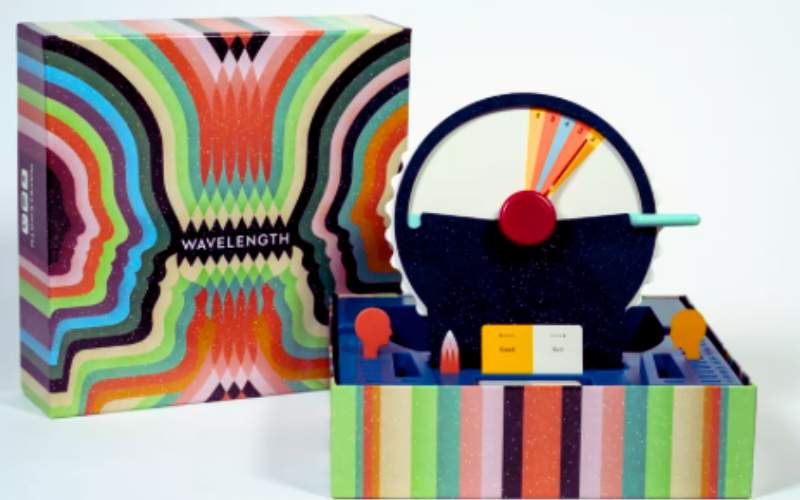
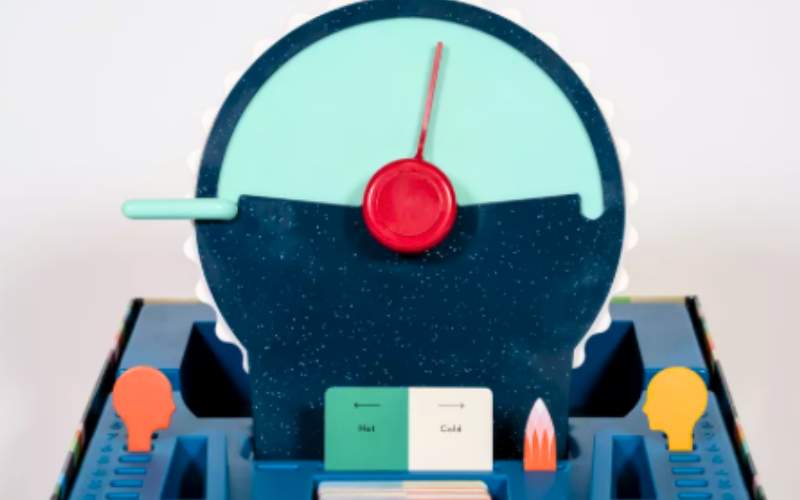
The game uses a physical dial with a hidden target zone. One player (the “psychic”) sees the target’s position on a spectrum card (like GOOD ↔ EVIL or FANCY ↔ TRASHY) and gives a clue word or short phrase. Everyone else sees only the spectrum endpoints and has to place the dial where they think the psychic’s clue belongs.
How it plays
Psychic draws a spectrum card, secretly sets the target, and gives one clue. The team discusses—sometimes intelligently, sometimes like a debate club fell into a meme—and then rotates the dial to lock in a guess. You score if your guess overlaps the hidden target zone, and you can usually gamble for extra points by narrowing in further once you’ve “hit.” The tension is the sweet spot: do you play it safe and aim broad, or trust your shared brain and go for the big payoff?
Why the pacing works
- Early game: everyone is learning each other’s definitions (“Wait, you think spicy is a personality?”)
- Midgame: the table gets better at reading the psychic, and clues become bolder and funnier
- Late game: teams start doing galaxy-brain arguments with total confidence… sometimes correctly
Table feel
Wavelength is talky, inclusive, and big on laughs. It’s best with 6+ because the discussion becomes the entertainment—more voices means more angles, and the debate is half the fun. It can play at 2–4, but it shines when the room becomes a mini panel show.
Who it’s for
- Groups who love conversation-heavy party games
- Players who enjoy word association, debate, and reading how friends think
- Best for game nights where you want laughter without rules weight
- You’ll like it if you want something clever that still welcomes beginners
Less ideal for
- Quiet groups who don’t like open discussion
- Tables with big language gaps (it’s not impossible, but nuance matters)
- Anyone who hates “there isn’t one correct answer” style games
Desert Meeples Beginner Tip + Verdict
New to Wavelength? As the team: don’t argue “what the word means.” Argue “what the psychic probably means.” Ask one grounding question: Are we aiming literal or vibe? That single decision fixes 80% of the chaos. As the psychic: give clues that land in the middle of the spectrum, not the extreme—extremes make the game weirdly harder because everyone assumes you’re being clever.
Verdict: Wavelength is a top-shelf party game because it’s simple, social, and endlessly replayable—every group generates its own running jokes and “how are we friends” moments. It’s basically Codenames’ chatty cousin: less pressure, more discussion, and a whole lot of high-fives when your team nails the exact kind of nonsense you meant.

