
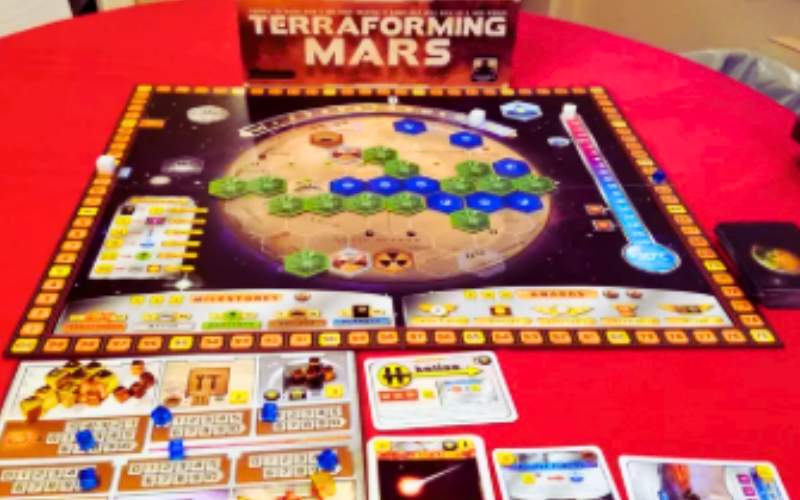
Quick Specs
 Strategy / Engine Building / Tableau
 12+
12+ ~3.3/5 (Medium–Heavy)
 1–5 (best at 2–4)
 ~90–150 min (can run longer with new players)
 Tableau/Engine Building, Card Drafting (variant/common), Resource Management, Variable Player Powers (corporations), Multi-Track Progress (terraform parameters), Milestones & Awards, Map Placement (cities/greeneries)
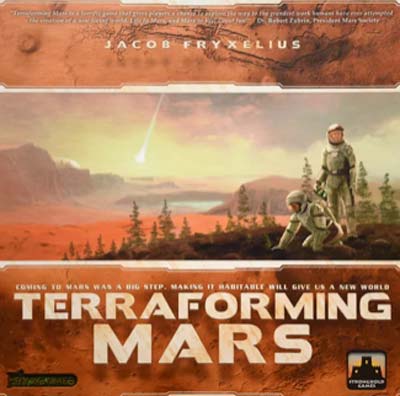
Terraforming Mars is the game where you start as a hopeful corporation with a dream and end as a spreadsheet-powered space tyrant who can convert heat into money into plants into points into smug satisfaction. It’s big, ambitious, and deeply replayable—an engine-building sandbox where your plan evolves based on what projects you draw and what the table is racing for.
What it is
This is a medium-heavy strategy game about raising Mars’s temperature, oxygen, and oceans while building an economic engine that scores you points in multiple ways. The hook is simple: everything you do helps terraform (which pushes the game toward the end) while also helping you (resources, discounts, combos, scoring). The challenge is choosing when to invest in your engine and when to start converting that engine into points before someone else ends the party.
The setup
You pick a corporation (your special ability + starting resources), set up the board with spaces for cities, greeneries, oceans, and bonuses, and start cycling through generations. Each generation you’ll gain income, play project cards, and decide whether you’re pushing the global terraforming tracks or quietly building an unstoppable combo pile.
How it plays
The core loop is wonderfully greedy: your cards give you new production, discounts, tags that unlock other effects, and ways to place tiles on the map for bonuses and points. You’ll spend money (and other resources) to play projects, then your production grows, and suddenly you’re doing bigger turns. The tension comes from timing and focus: if you only build engine, you’ll be rich and irrelevant when the game ends. If you only terraform fast, you might end the game… while your opponent’s engine prints points every round.
Terraforming itself is a shared clock. When oceans, temperature, and oxygen hit their targets, the game ends. That means every “helpful” terraforming action is also a strategic decision about pace—and yes, someone will absolutely speed-run the end while you’re still lovingly assembling your science combo like it’s a hobby.
Why the pacing works
- Early game: you’re broke, building production, and making “future me will handle it” decisions
- Midgame: engines come online, turns get swingy, and the board starts filling with player identity (cities, forests, control)
- Late game: conversion season—cash your engine into points, grab endgame tile placements, and race milestones/awards before time runs out
Table feel
It’s interactive, but not in a “take-that” way. You’ll feel the competition through:
- contested map spaces and placement bonuses
- milestones and awards (racing and funding)
- pacing pressure (who’s pushing terraforming tracks)
- drafting/sniping key cards (if your group drafts)
It’s best at 2–4. At 5, it can get long, and the downtime between turns becomes noticeable unless everyone plays briskly. The vibe is very “build your machine,” with the table constantly glancing up to see who’s about to end the game.
Who it’s for
- Groups who love engine building, big card variety, and long-term planning
- Players who enjoy combo chaining and building an identity (science, plants, space, money, etc.)
- Best for game nights where you want a meaty main event
- You’ll like it if you like games that feel different every time because the cards steer the story
Less ideal for
- Not great for players who dislike long games or reading lots of card text
- Avoid if your group struggles with analysis paralysis (there are always options)
- Also note: luck of the draw is real; drafting helps if your table wants more control and fairness
Desert Meeples Beginner Tip + Verdict
New to Terraforming Mars? Pick a lane early: engine first, then points. Aim to increase production in the first few generations, but keep one eye on the endgame clock—if terraforming is moving fast, start converting sooner. Also, don’t ignore the board: smart city/greenery placement is sneaky points, and milestones/awards are basically “free” value if you plan for them instead of remembering them at the end like a tragedy.
Verdict: Terraforming Mars is a modern strategy staple: huge replayability, satisfying engine growth, and that classic “my last turn was incredible” feeling. It can run long and it can overwhelm new players with card text, but if your group enjoys deep planning and big combo payoffs, it’s one of the best “build a machine and watch it hum” experiences out there.

