
Quick Specs
 Party / Microgame / Deduction
 10+
10+ ~1.2/5 (Light)
 2–4 (best at 4, works great at 2)
 ~15–20 min
 Deduction, Hand Management (one-card “hand”), Player Elimination (per round), Push-Your-Luck, Take-That
Love Letter is what happens when a game turns “I have one card” into a full-blown mental duel. It’s tiny, fast, and deceptively sharp—15 minutes of smiling politely while you try to figure out what everyone’s holding and then gently ruining their day with a well-timed guess. It’s elegant, quick to teach, and perfect for that moment when you want something clever without committing your whole evening.
What it is
This is a micro deduction game about delivering a love letter to the Princess by using (and surviving) the influence of the people around her. Mechanically, it’s simple: you’re trying to be the last player standing each round, or end the round holding the highest-value card. The trick is that you only ever hold one card, draw one, play one—so every turn is a clean decision with real consequences.
The setup
Shuffle a small deck of character cards with different values and abilities. Each round, players start with one hidden card in hand. A card is removed from the game (secretly), which keeps information imperfect and prevents full certainty. Then the round begins: draw a card, play a card, do what it says, and watch the table narrow down like a tiny courtroom.
How it plays
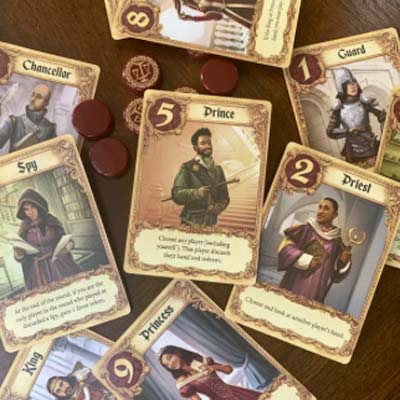
On your turn you draw one card, giving you two. You choose one to play, resolve its effect (usually targeting another player), and keep the other as your hidden card. That’s it. But every card is a weapon: some let you guess what another player has, some force discarding, some give protection, and some are so powerful you’re not allowed to hold them with certain other cards. The tension comes from reading the room and tracking what’s been played. The deck is small, so memory matters—if you’ve seen three low cards already, that “safe” guess suddenly looks a lot sharper.
Rounds end quickly because players get knocked out, and that’s part of the charm: elimination is light and fast, and you’re back in immediately for the next round.
Why the pacing works
- Early game: quick information, quick bluffs, and people testing the waters with “harmless” plays
- Midgame: the table becomes a deduction puzzle—everyone’s counting cards and watching reactions
- Late game: it turns into pure brinkmanship: do you make the aggressive play now, or hold your high card and pray nobody forces a discard?
Table feel
Love Letter is compact and punchy. Turns take seconds, interaction is direct, and the game thrives on small tells and social reading without requiring loud table talk. It’s great at 4, where the chaos and targeting feel lively, and it’s also excellent at 2 as a tight, tactical duel. It’s one of the easiest “non-gamers can play this” games that still makes experienced players sit up and focus.
Who it’s for
- Groups who love quick, clever games with constant interaction
- Players who enjoy deduction, timing, and light bluffing
- Best for travel, cafes, fillers between heavier games, and “we’ve got 15 minutes” moments
- You’ll like it if you want something tiny that still feels strategic
Less ideal for
- Not great for players who dislike being targeted or knocked out (even briefly)
- Avoid if your group hates “take-that” effects, even in cute form
- Also note: luck exists because of draws, but good play is about improving your odds and reading what’s left
Desert Meeples Beginner Tip + Verdict
New to Love Letter? Don’t overthink the story—focus on information. Watch what gets played, remember what’s already gone, and pay attention to who suddenly looks very comfortable after drawing. Also: sometimes the best move is not the flashiest one. A boring play that keeps you safe can win more rounds than a heroic swing that gets you eliminated immediately.
Verdict: Love Letter is a pocket-sized classic: fast, sharp, and endlessly replayable. It’s the perfect “one more round” game—because rounds are quick, revenge is immediate, and you’ll spend the whole night saying, “Okay, but THIS time I’m not getting Guard-sniped on turn one.”

