Quick Specs
 Party / Social Deduction / Team Hidden Roles
 12+
12+ ~2.3/5 (Light–Medium)
 5–11 (best at 7–9)
 ~45–90 min
 Hidden Roles, Team Deduction, Voting, Hand Management (navigation cards), Semi-Cooperative Play, Role Powers, “Traitor in the Crew”

Feed the Kraken is the social deduction game where you’re not just arguing about who’s evil—you’re arguing about where the ship is going while someone is actively trying to steer it into a sea monster’s mouth. It’s loud, dramatic, and deliciously messy, because every “navigation decision” is also a loyalty test. One person just wants you to reach port, one faction wants you to reach a different port, and one absolute menace wants the whole crew to become calamari.
What it is
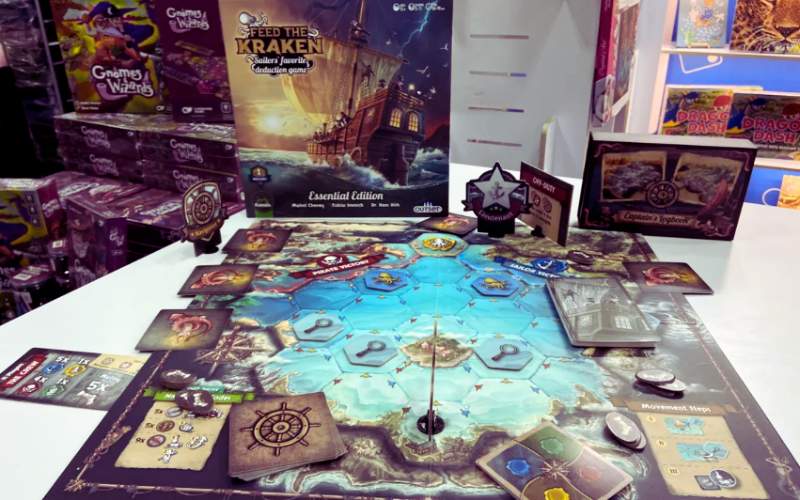
This is a hidden-role team deduction game with a shared objective that physically shows up on the board: the ship’s route. Good and evil aren’t just abstract teams here—their choices literally move the ship toward different endings. That makes the table talk sharper because you can point at the map and say, “So… why are we heading that way, captain?”
The setup
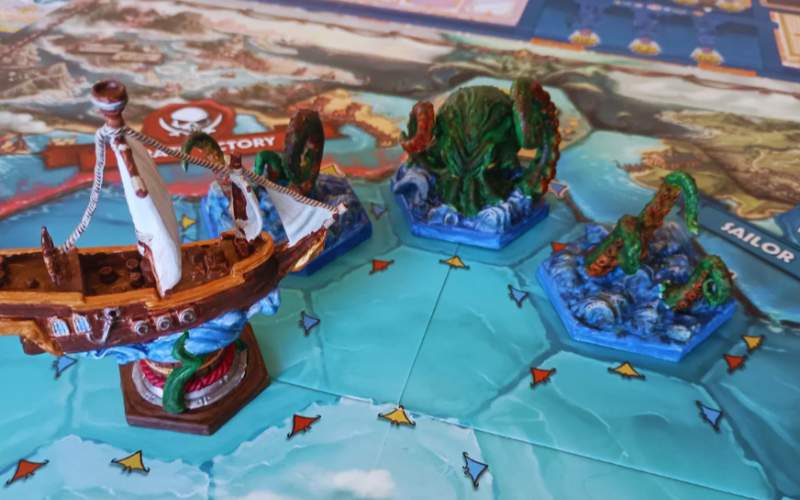
Players are secretly assigned to factions. Most of the crew wants the “good” outcome, a smaller group wants the “bad” outcome, and there’s usually one wildcard who wants the ship to reach the Kraken. The ship starts at sea with two possible destinations on the board, and the crew will take turns choosing leaders and resolving navigation that inches the ship closer to one ending or another. The map does a lot of heavy lifting: it gives everyone a shared, visible scoreboard of suspicion.
How it plays
Each round, a captain (and usually another officer role) is chosen through discussion and a vote. That leadership then handles a small hand-management puzzle: players see and pass around navigation cards, and the final choice determines how the ship moves. Like all great deduction games, it’s never just about the outcome—it’s about the story: who supported the leadership, who pushed the vote through, who argued hard for a specific direction, and who suddenly got very quiet when the ship moved toward danger.
As the game progresses, roles and powers matter more. Players gain abilities, information gets sharper (and more weaponized), and the conversation shifts from vibes to receipts: “You put them in charge twice. Why?” “Why did you block that vote?” “Why are you acting like the map is a suggestion?”
Why the pacing works
- Early game: everyone is “just trying to be helpful,” and the ship drifts suspiciously fast in one direction
- Midgame: factions start to reveal themselves through voting patterns, and every leadership pick becomes a mini-trial
- Late game: the route tightens, options shrink, and one decision can end it—usually right when the table has peak confidence and incomplete information (the classic)
Table feel
This is high interaction, high table talk, and medium rules weight. It’s not hard, but it’s more structured than pure party bluffing, which helps keep big groups focused. The map and shared route give players something concrete to argue about, which is great for beginners who struggle with “pure vibes deduction.” Expect big speeches, dramatic accusations, and sudden alliances that last exactly one vote.
Best player counts tend to be 7–9, where there’s enough room for deception and misdirection without the conversation becoming a full-time job. With the right group, it feels like a chaotic pirate courtroom with a nautical theme and a monster waiting off-stage.
Who it’s for
- Groups who love social deduction with clear objectives and lots of debate
- Players who enjoy bluffing, persuasion, and tracking vote history
- Best for game nights where you want one “main event” everyone commits to
- You’ll like it if you want a deduction game where the board state tells a story
Less ideal for
- Quiet groups or players who hate being accused or put on the spot
- Tables that dislike long discussions or negotiation-heavy turns
- Anyone who wants pure logic deduction without social pressure
- Groups that struggle with “it’s just a game” energy—this one can get loud
Desert Meeples Beginner Tip + Verdict
New to Feed the Kraken? Don’t just watch what happens—watch who made it happen. Track who nominates whom, who votes yes, and who keeps arguing for “slightly questionable” routes with extremely confident logic. Also: if someone says “Trust me” three times in one round, congratulations—you’ve found at least one problem.
Verdict: Feed the Kraken is a fantastic social deduction “event” game: clear stakes, constant conversation, and a board that turns suspicion into a visible route toward doom. With a talkative group, it’s an all-night highlight—half deduction, half theatre, and 100% the reason your ship absolutely should not be run by a committee.