
Quick Specs
 Heavy Economic Strategy / Network Building
 14+
14+ ~3.9/5 (Heavy)
 2–4 (best at 3–4)
 ~60–120 min
 Hand Management (card-driven actions), Network Building (canals/rails), Resource Economy (coal/iron/beer), Shared Infrastructure, Market Timing
Brass: Birmingham is the kind of game that makes you feel like a Victorian business genius… right up until you realize you’ve built a beautiful network that can’t actually do anything because you forgot one tiny detail, like coal. It’s dense, sharp, and deeply interactive—an economic knife fight where everyone looks polite while quietly using your infrastructure, draining the market, and winning by six points because they timed beer like it was insider trading.
What it is
This is a heavy economic strategy game about building industries and connecting cities during the Industrial Revolution. You’re managing money, timing, and access to resources while trying to turn your little empire into victory points. It’s famous for being punishing in a “fair” way: if you plan well, you feel brilliant; if you don’t, the game doesn’t yell at you—it just lets you slowly understand what you did wrong.
The setup
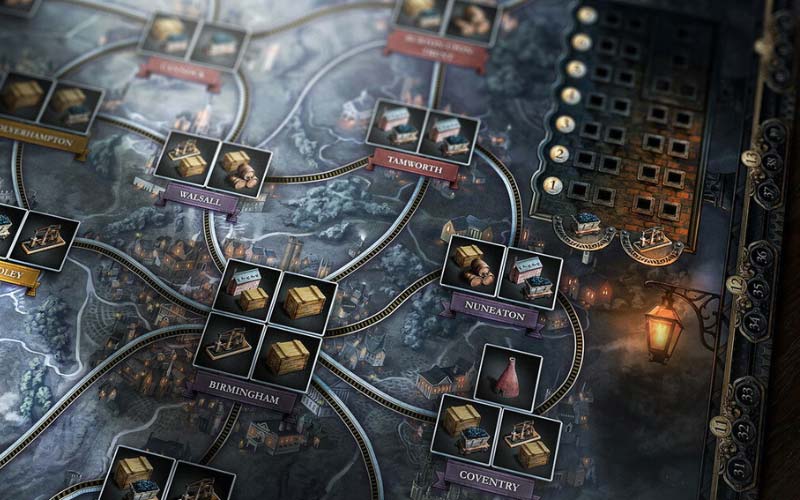
You’ve got a board full of cities, a market for key resources (coal, iron, beer), and players with hands of location/industry cards that determine what actions you can take. The game runs across two eras—canals and then railways—so your long-term plan has to survive a full economic mood swing halfway through.
How it plays
On your turn you take actions using cards to build industries, develop (clear out older tech), connect cities, sell goods, take loans, and generally attempt to look like you’re in control. The core tension is that you’re never just building “your stuff.” You’re building in a shared ecosystem where access to coal/iron/beer and the timing of sales can open doors for everyone—or slam them shut. You’ll regularly have turns that feel like: “This is perfect, I just need one thing,” followed by ten minutes of staring at the board realizing that “one thing” is the entire game.
Why the pacing works
- Early game: you’re broke, excited, and making big plans with small money
- Midgame: networks start to matter, the market tightens, and every action has consequences for other players
- Late game: the rails era turns into a points sprint where timing and efficiency matter more than your dreams ever did
Table feel
This game is interactive in the best, most stressful way. You’re not attacking pieces, but you’re absolutely affecting each other constantly—through shared links, shared markets, and shared opportunities. It’s the kind of design where “helping” an opponent can be correct because it also helps you, and then later you both regret it. It’s best at 3–4 because the map feels alive and contested, but it still plays well at 2 if you want a tighter, more controlled duel.
Who it’s for
- Groups who love heavy strategy with real player interaction (not multiplayer solitaire)
- Players who enjoy planning, timing, and adapting when the board changes
- Best for experienced tables who want a meaty “main event” game night
- You’ll like it if you enjoy resource economies where every choice echoes for the next hour
Less ideal for
- Not great for casual nights, new gamers, or anyone who hates being cash-poor and choice-limited early
- Avoid if your group wants constant “funny moments” more than deep decisions
- Also note: the teach is manageable, but it’s not a breezy one—expect the first game to be part play, part learning
Desert Meeples Beginner Tip + Verdict
New to Brass: Birmingham? Don’t try to do everything. Pick a direction early, get your network online, and remember the game’s rude truth: if you can’t reliably access resources, you don’t have an engine—you have a museum exhibit. Also, loans aren’t failure… they’re just your Victorian-era “I’ll fix it in post.”
Verdict: Brass: Birmingham earns its reputation as a heavyweight classic: tense economy, delicious interaction, and that rare feeling that every turn matters. It can be intimidating, but if your group wants a deep, competitive strategy game where the table state feels alive, this one doesn’t just deliver—it prints money (just… not always for you).

