
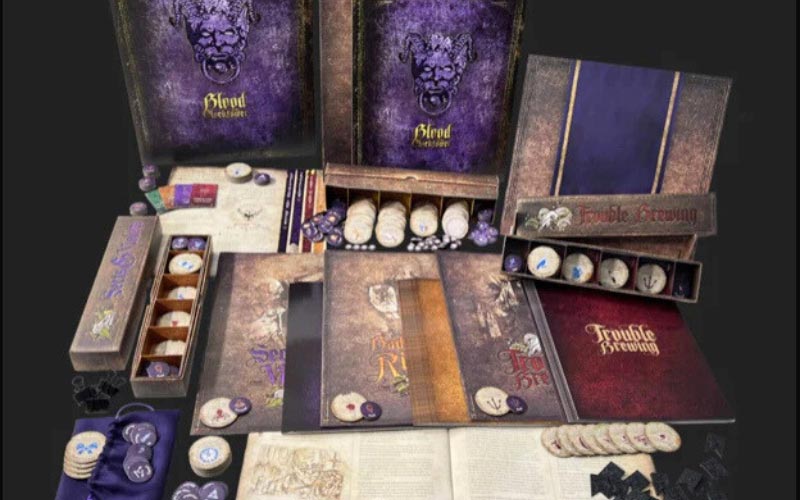
Quick Specs
 Party / Social Deduction (storyteller-moderated)
 14+
14+ ~3.0/5 (Medium)
 5–20 (plus 1 Storyteller)
 ~30–120 min)
 Hidden Roles, Team Deduction, Bluffing, Storyteller Moderation, Night/Day Phases, Information Control
Blood on the Clocktower is what happens when Werewolf/Mafia grows up, gets a director’s chair, and decides nobody has to sit out just because they died. It’s a big, theatrical social deduction experience where the room becomes a living rumour machine—accusations, alliances, “wait, say that again,” and the kind of table-wide gasps you normally only hear at a penalty shootout.
What it is
This is social deduction as an event. Two teams—Good and Evil—are trying to figure out who’s who, but the game is run by a Storyteller who guides the flow, resolves abilities, and essentially plays conductor for the chaos. The result feels more like an interactive mystery show than a quick party filler.
The setup
Everyone gets a character with a power, and those powers matter. Good players are trying to identify and execute the Demon before Evil outnumbers the town, while Evil is trying to survive, misdirect, and pick people off. The best twist: even if you die, you’re still in the game—talking, voting, and staying involved—so the energy doesn’t collapse halfway through. (Your “dead” vote just becomes a limited resource, which keeps it spicy.)
How it plays
The game cycles through night and day. At night, the Storyteller quietly collects info and resolves abilities (including Evil’s kills). During the day, the village explodes into discussion: sharing info, comparing stories, catching contradictions, and eventually nominating and executing someone. Then you do it again, but with higher stakes and weirder lies. The tension comes from the information economy: some info is true, some is poisoned, some is incomplete, and some is “technically accurate in the most unhelpful way possible.”
Why the pacing works
- Early game: everyone is information-dumping and overconfident, like they’ve cracked it in 12 minutes
- Midgame: the web tightens—bluffs get tested, voting blocs form, and you start tracking who benefits from confusion
- Late game: it becomes a courtroom drama with jump scares—one execution can win it, lose it, or reveal you’ve been living in a lie for 90 minutes
Table feel
This game is loud in the best way: constant conversation, shifting narratives, and big “wait… that means…” moments. It’s also heavier than it looks—not because the rules are impossible, but because it asks players to manage social pressure, memory, bluffing, and a growing pile of claims. That’s why it shines with a group that’s willing to lean into the performance and keep things playful even when the accusations get sharp.
Who it’s for
- Groups who love high-energy social deduction as a full activity, not a quick round
- Players who enjoy storytelling, bluffing, and following a thread of logic through chaos
- Best for game nights, clubs, and gatherings where you can seat a big circle and commit to the experience
- You’ll like it if you want a deduction game with structure, roles that matter, and no early player elimination
Less ideal for
- Quiet groups or tables that dislike confrontation and public debate
- Players who hate being put on the spot or improvising explanations
- Any group without a willing Storyteller (this role matters—a lot)
- Tables that want a quick 20-minute hit; Clocktower wants time to cook
Desert Meeples Beginner Tip + Verdict
New to Clocktower? Your job isn’t to “solve the whole game.” Pick one lane: either be the person who tracks votes and social patterns, or be the person who sanity-checks claims and timing. Also: share info with intent. A clean, simple statement at the right moment beats a five-minute monologue that makes everyone forget what year it is.
Verdict: Blood on the Clocktower is social deduction with production value—bigger, smarter, and more “event night” than most games in the genre. If your group loves table talk and can keep accusations fun, it delivers unforgettable highs. If your group doesn’t like pressure or needs a calmer vibe, this one can feel like signing up for an improv trial you didn’t study for (and yes, you’re still somehow enjoying it).

