
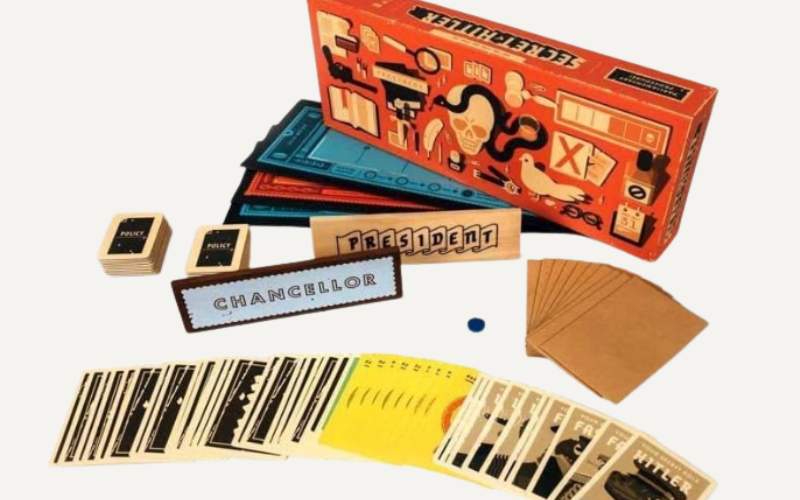
Quick Specs
 Party / Social Deduction
 13+
13+ ~1.7/5 (Light–Medium)
 5–10 (best at 7–10)
 ~45 min (often 30–60)
 Hidden Roles, Team Deduction, Bluffing, Voting, Hand Management (policy choice), Moderator-light structure (President/Chancellor)
Secret Hitler is the kind of game that turns a friendly table into a suspicious little parliament in about three minutes. It drops you into a fictionalized 1930s political crisis where nobody’s “solving” anything so much as trying to survive a room full of confident liars. It’s loud, fast, and instantly engaging—built for big reactions, bold accusations, and those delicious end-of-game reveals that make everyone yell either “I KNEW IT!” or “HOW DID WE FALL FOR THAT?”
What it is
This is social deduction at its most approachable: minimal rules overhead, maximum table talk. You can teach it quickly, get rolling even with newer players, and still have enough depth to keep returning groups arguing about vote history like it’s a sports replay.
The setup
Everyone gets a hidden role. Some players are on one team, some on the other, and one role has a special win condition that makes the whole table sweat. Your job is simple: figure out who you can trust before the game ends—because the end can come suddenly, and usually does.
How it plays
Each round follows a clean rhythm: a President nominates a Chancellor candidate, the table votes yes/no, and if the government passes, President and Chancellor secretly choose which policy gets enacted. That’s the whole engine—and it’s exactly why it works. A “bad” policy hits the table and suddenly everyone’s doing courtroom math: was that a betrayal, or did the deck force it? And why are you so calm right now?
Why the pacing works
Secret Hitler has a great arc that naturally escalates the drama.
- Early game: chaos, vibes, confident guesses, and “trust” forming way too fast
- Midgame: voting records matter, accusations get specific, patterns emerge (who protects whom, who steers nominations)
- Late game: brinkmanship—one election or one policy can end it, and everyone is 110% sure while knowing 60%
Table feel
On paper it’s light: nominate, vote, pass a policy. In practice, it’s a social pressure cooker. You’re not just doing logic—you’re reading tone, timing, consistency, and how people react when the heat turns up. Interaction is constant: even when it’s not your turn, you’re debating, voting, watching reactions, testing alliances, and sometimes voting purely to see what someone does under stress. It’s especially strong at 7–10, where it becomes full political theatre; at 5–6, it’s tighter and more surgical.
Who it’s for
- Groups who love high-energy table talk and social reading
- Players who enjoy bluffing + reading people more than solving a pure logic puzzle
- Parties with 7–10 where you want one game everyone can focus on
- Tables that want dramatic reveals and big endgame swings
Less ideal for
- Quiet groups or players who hate being accused/pressured
- Tables where confrontation turns personal instead of playful
- Anyone uncomfortable with the theme (if there’s hesitation, pick a lighter social deduction skin)
Desert Meeples Beginner Tip + Verdict
New to social deduction? Good news: you don’t need a galaxy brain. Focus on two things: voting history and who keeps “accidentally” enabling the same people. The best plays aren’t complicated—they’re consistent stories, calm explanations, and noticing who gets defensive when the questions get pointed.
Verdict: Secret Hitler is sharp, loud, and wildly replayable with a talkative group. Expect big speeches, bigger accusations, and an endgame that turns the vote track into post-match analysis like it’s a football replay. Just make sure your group is comfortable with the theme—and if not, keep the distrust and grab a lighter social deduction alternative.

