
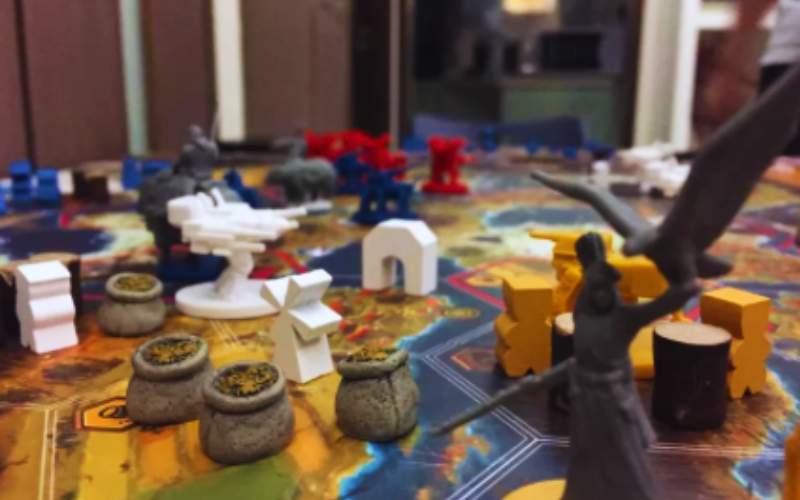
Quick Specs
 Strategy / Area Control (low conflict) / Engine Building
 14+
14+ ~3.4/5 (Medium–Heavy)
 1–5 (best at 3–4)
 ~90–120 min
 Action Selection (player mat), Engine Building, Resource Management, Area Control, Asymmetric Factions, Combat (limited), Objective/Triumph Race
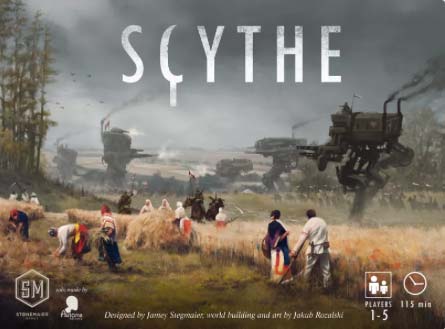
Scythe looks like a war game—mechs, maps, and stern stares—but it’s actually a cold, efficient economy puzzle wearing a very intimidating coat. Yes, there’s conflict, but most of the time you’re building engines, optimizing turns, and expanding your footprint like a polite landlord with a giant robot. The tension comes from the fact that everyone is doing the same thing at once: quietly getting rich, quietly getting stronger, and quietly positioning for the moment the game ends before you’re “fully ready.”
What it is
This is a medium-heavy strategy game where you’re racing to hit endgame triggers (stars) by doing well at a handful of goals: building, upgrading, fighting (sometimes), completing objectives, and generally being efficient. It’s not a “wipe them off the map” game—it’s more like a tense cold war where threats matter as much as battles.
The setup
Each player gets an asymmetric faction and a player mat that determines which actions pair together. That mat is a big deal: your whole game is about finding the rhythm that lets you take a top action (move, trade/produce, bolster, etc.) while also powering up a bottom action (build, deploy mechs, enlist recruits, upgrade). Early on you’re resource-poor and action-limited. Midgame you feel like a machine. Late game you’re trying to cash in everything before someone ends it.
How it plays
On your turn you pick one of four action rows. You do the top action, and if you can afford it, you also do the bottom action in that same row. That’s the core loop: every turn is a mini puzzle of “What gives me value now, and what sets up future value?” It feels great because you’re always progressing—making your engine smoother, getting stronger, spreading onto the map, and collecting little advantages.
The tension comes from timing and positioning. You can’t turtle forever because the game ends when someone hits the star threshold, and that can happen faster than new players expect. Also, the map matters: controlling territory and resources can swing points hard, and the mere presence of a mech can change how everyone behaves.
Why the pacing works
- Early game: you’re broke, you’re slow, and you’re trying to build an engine without wasting turns
- Midgame: the board opens up, combos start firing, and you begin watching opponents for endgame tempo
- Late game: it becomes a sprint—grab points, threaten space, maybe fight once, and end it while your engine is peaked
Table feel
Scythe is interactive in a “pressure” way more than a “punching” way. Combat exists, but it’s limited and costly enough that it’s usually a calculated move, not constant brawling. That’s great for groups who want tension without nonstop conflict. It’s best at 3–4, where the map feels contested and the tempo is lively. At 2 it can feel more spacious and chess-like; at 5 it can run longer and the board can feel crowded depending on the table.
Who it’s for
- Groups who love medium-heavy strategy with strong progression and table tension
- Players who enjoy optimizing, planning, and racing an endgame clock
- Best for experienced groups who want a “main event” with lots of satisfying decisions
- You’ll like it if you want area control without constant fighting
Less ideal for
- Not great for players expecting a combat-first wargame (most fights are one or two big moments, not the whole meal)
- Avoid if your group dislikes engine optimization or gets stuck in analysis paralysis
- Also note: early turns can feel slow for first-timers until they “see” the action rhythm
Desert Meeples Beginner Tip + Verdict
New to Scythe? Don’t treat it like a mech battle simulator. Your real job is building an efficient turn cycle: produce when it matters, upgrade to make your actions cheaper/smoother, and aim for steady star progress instead of one massive master plan that takes 12 turns to start. Also: watch the table’s star count—if someone is at 4–5 stars, you’re officially in “stop building dreams and start scoring points” mode.
Verdict: Scythe is a gorgeous, tense strategy game that rewards smart planning and even smarter timing. It’s not about constant combat—it’s about presence, efficiency, and ending the game on your terms. If your group likes strategic pressure with big “now we fight” moments instead of nonstop aggression, this one delivers the full dieselpunk dinner.

