
Quick Specs
 Family / Abstract / Tile-Laying
 6+
6+ ~1.5/5 (Light)
 2–4 (best at 2)
 ~30–45 min
 Pattern Building, Set Collection, Hand Management, Spatial Puzzle, Simple Scoring (line building)
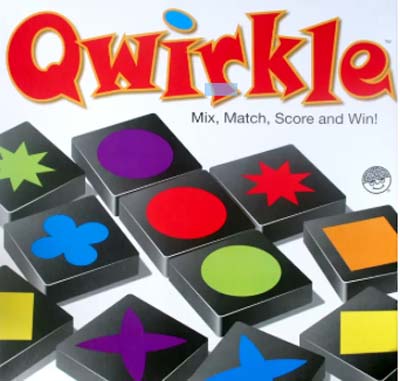
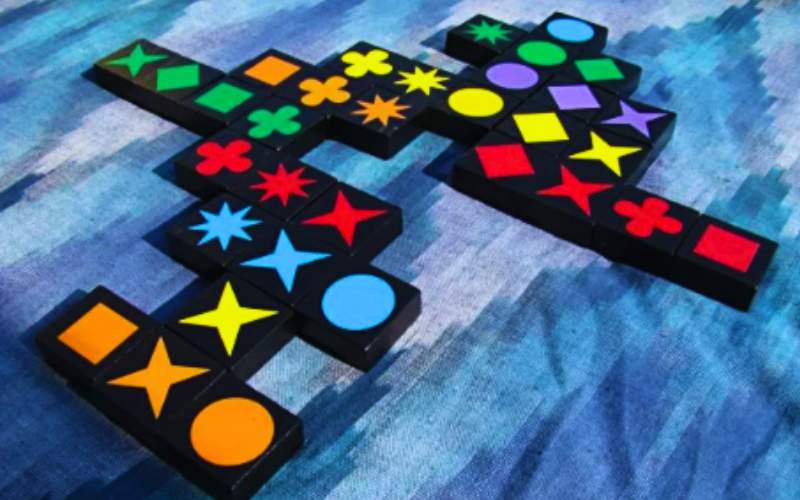
Qwirkle is the kind of game that looks like “nice colorful tiles” and then quietly turns into a ruthless little puzzle where everyone’s counting spaces and pretending they’re not. It’s basically the love child of dominoes and Scrabble scoring energy—simple rules, surprisingly thinky decisions, and that one moment every game where someone drops a huge line and the table goes, “Oh… so we’re playing like that today.”
What it is
This is an abstract tile-laying game where you build lines using either matching colors or matching shapes. The catch is that in any single line, you can’t repeat the same shape or the same color. So you’re constantly trying to extend lines, set yourself up for big plays, and avoid helping your opponents too much (you will help them anyway; the board is a shared workplace).
The setup
Everyone starts with a small hand of tiles, each tile showing a color + a shape. The table is your shared layout, and the game grows organically as players add tiles, creating a sprawling web of scoring opportunities.
How it plays
On your turn you either place tiles from your hand in one play (usually 1–6 tiles) or swap some tiles and pass. When you place tiles, they must form a straight line and match either by color or by shape, following the “no duplicates” rule. You score points equal to the length of every line you extend or create. Complete a line of six unique tiles and you score a Qwirkle—the game’s big “boom” moment.
The tension comes from hand management. Do you place a small safe move, or hold tiles to try to engineer a monster turn later? And when do you cash in a good play before someone else closes the space you needed?
Why the pacing works
- Early game: the board is open, everything feels possible, and people play “friendly” moves
- Midgame: the layout becomes a puzzle grid, and turns start to swing bigger
- Late game: it’s all about timing—finding the last perfect space, blocking quietly, and dropping a Qwirkle like you’ve been planning it for weeks
Table feel
Qwirkle is calm, accessible, and quietly competitive. There’s no direct confrontation, but there is plenty of indirect interaction because every tile you place changes what’s available. It’s best at 2 players if you want tighter control and more tactical blocking. At 3–4, it’s a bit more chaotic and swingy, which some groups love because big scoring opportunities appear more often.
Who it’s for
- Groups who love simple rules and satisfying pattern building
- Players who enjoy spatial puzzles and optimizing without heavy theme
- Best for families, casual nights, and mixed-experience tables
- You’ll like it if you want something Scrabble-adjacent without word stress
Less ideal for
- Not great for players who want theme, story, or direct interaction
- Avoid if your group dislikes abstract scoring and “quiet” competition
- Also note: analysis-paralysis players can slow it down, because the board invites scanning for the perfect placement
Desert Meeples Beginner Tip + Verdict
New to Qwirkle? Don’t hoard forever chasing the perfect mega-turn—cash in good placements before the board closes. Try to keep a hand with flexible options (a mix of colors and shapes), and always look for “two-line” placements where one tile scores in multiple directions. Also: if someone is building toward a Qwirkle, assume they are and act accordingly.
Verdict: Qwirkle is a clean, satisfying family abstract: easy to learn, surprisingly strategic, and endlessly replayable because the board evolves differently every game. It’s quiet competition with big scoring pops—proof that you don’t need dragons to get dramatic table reactions.

