
Quick Specs
 Cooperative / Strategy / Crisis Management
 8+
8+ ~2.4/5 (Light–Medium)
 2–4 (best at 4)
 ~45 min
 Cooperative Play, Action Point Allowance, Set Collection, Hand Management, Variable Player Powers, Map Movement, Escalating Threat Deck
Pandemic is the co-op classic where you look at a world map and think, “We can handle this,” and the game immediately replies, “That’s adorable.” You’re a team of specialists racing to stop outbreaks and discover cures before everything spirals. It’s tense, clean, and super readable—even for beginners—because the problems are visible on the board and the stakes rise in a way you can feel turn by turn.
What it is
This is a cooperative strategy game about managing a global crisis. On your turn you take a few actions—move, treat disease cubes, share knowledge, build research stations—then the game hits back by infecting cities and occasionally triggering outbreaks that chain across the map. You win by curing all diseases. You lose if outbreaks get out of hand, a disease runs out of cubes, or time runs out via the player deck.
The setup
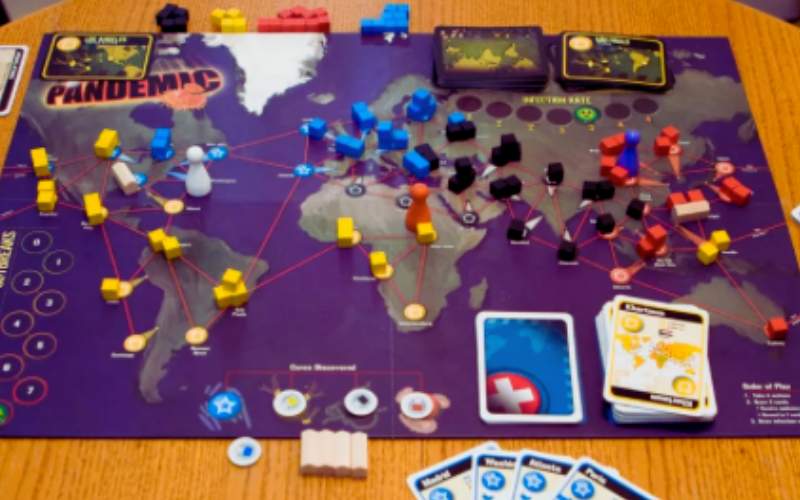
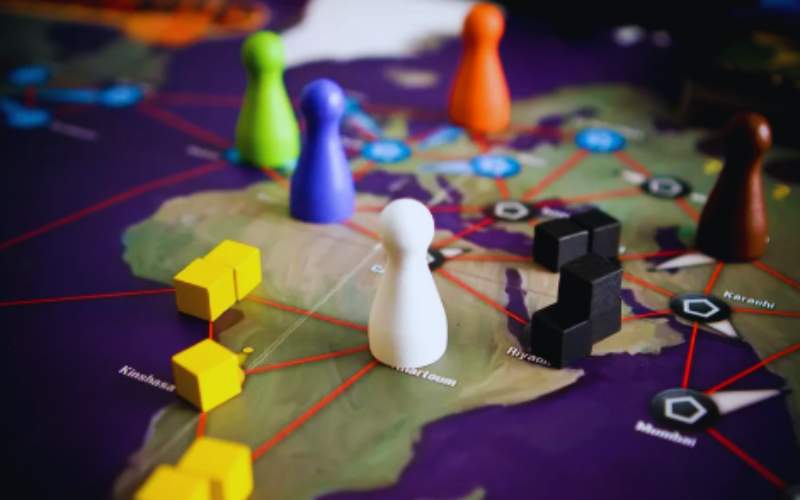
The board is the world, with cities connected by lines and disease cubes ready to spread. Each player gets a role with a special power (and Pandemic’s roles are the secret sauce—small abilities that make teamwork feel real). You also set up two decks: one for player cards (where you’re chasing sets to cure diseases) and one for infection (which determines where trouble appears and reappears).
How it plays
Every turn is the same satisfying loop: you do your best with limited actions, then the game escalates. You’ll often face the core Pandemic question: do we solve today’s problem, or prevent tomorrow’s disaster? Treating cubes is urgent, but collecting the right cards is how you actually win. And the game constantly tests your priorities with those famous “oh no” moments where infection spikes and a city you just stabilized lights up again.
The tension is not from hidden information—it’s from time, pressure, and imperfect options. You can usually see what’s coming. You just can’t stop all of it.
Why the pacing works
- Early game: you’re setting up research stations, gathering cards, and trying to look in control
- Midgame: outbreaks start chaining, the map gets messy, and you’re making real trade-offs every turn
- Late game: pure co-op drama—one great sequence can win, one bad draw can flip the table into panic mode
Table feel
Pandemic is collaborative, tactical, and very discussion-heavy in a good way. It shines at 4 because the role synergy clicks and the board feels like a shared puzzle, but it’s also excellent at 2–3 with tighter coordination. The biggest “table risk” is quarterbacking—one confident player trying to run everyone’s turns—because the game invites group planning. With the right group dynamic, it feels like a tense team mission; with the wrong dynamic, it can feel like watching someone else play.
Who it’s for
- Groups who love teamwork, planning, and high-stakes problem-solving
- Players who enjoy optimizing limited actions under pressure
- Best for families and mixed-experience groups ready for a “real” strategy co-op
- You’ll like it if you want a classic gateway-to-medium cooperative game
Less ideal for
- Not great for groups that dislike open discussion or shared decision-making
- Avoid if your table has a strong quarterbacking tendency (unless you set table rules)
- Also note: theme can feel a bit heavy for some players depending on context—worth being mindful
Desert Meeples Beginner Tip + Verdict
New to Pandemic? Don’t try to play whack-a-mole everywhere. Prioritize preventing outbreaks in high-risk clusters, build a research station or two early, and start coordinating card sharing sooner than feels necessary—new players often wait too long. And if your group has a “captain,” set a simple rule: everyone controls their own turn, suggestions are welcome, final say is theirs.
Verdict: Pandemic is a modern co-op pillar for a reason: clear rules, escalating tension, and that unbeatable feeling of pulling off a win by one turn with everyone contributing. It’s stressful in the best way—like a team heist where the alarms keep going off—but when the plan clicks, it’s pure table triumph.

