
Quick Specs
 Party / Social Deduction / Hidden Roles
 8+
8+ ~1.4/5 (Light)
 3–10 (best at 5–8)
 ~10–15 min per round)
 Hidden Roles, One-Round Deduction, Simultaneous Role Powers (night phase), Discussion + Voting, No Player Elimination (during play)

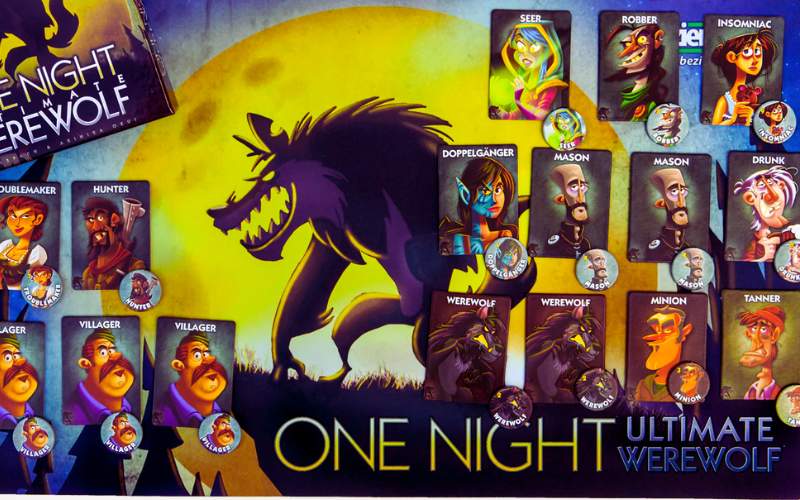
One Night Ultimate Werewolf is social deduction with the brakes removed. It takes the classic “Werewolf/Mafia” idea and compresses it into a single, frantic round where everyone stays involved the whole time. The result is fast, loud, and hilariously unreliable—in a good way—because the game is basically: “Here’s some information. Some of it might be true. Also, roles may have moved. Good luck.”
What it is
This is a one-round party deduction game. Everyone gets a secret role, a quick “night phase” happens where roles do actions (often swapping cards or learning information), then the table debates for a few minutes and votes to eliminate one player. The twist is the best part: your role at the start might not be your role at the end, so confidence is always suspicious.
The setup
You’ll have more roles than players, with a few sitting face-down in the center. Players start with one role card, close their eyes for the night phase, and roles wake up in order to do their powers—peek at cards, swap roles, mess with information, create confusion, the usual healthy village activities.
Because swaps happen, the game becomes a logic-and-social puzzle: you’re not just asking “who is the werewolf?” You’re asking “who was the werewolf, what changed, and who is lying about what they saw?”
How it plays
- Night phase (guided): roles wake up one by one and do quick actions (look, swap, etc.).
- Day phase (short debate): everyone talks, accuses, defends, reconstructs the night, and tries to build a story that doesn’t collapse under one follow-up question.
- Vote: everyone points at someone. One person gets eliminated. If the village hits a werewolf, good wins; if not, the werewolves win.
The tension comes from the time pressure and the information gap. You never have enough certainty, so the game rewards clean storytelling, good questions, and spotting who’s “performing confidence” instead of explaining details.
Why the pacing works
- Early seconds: instant chaos—people claim roles fast to control the narrative
- Mid discussion: the table tries to reconstruct events like it’s a conspiracy corkboard
- Final minute: pure brinkmanship—everyone locks in a vote while still unsure what team they’re on
Table feel
This is high-energy and very talky. It’s best when players can be loud and playful without taking accusations personally. There’s also a lot of “wait—if you swapped with me, then I’m… oh no” comedy, which makes it fantastic for groups that like big reactions. And because it’s so short, it’s easy to run multiple rounds and let the “meta” develop (revenge votes, trust circles, and the classic “I will never believe you again”).
Who it’s for
- Groups who love fast social deduction with lots of table talk
- Players who enjoy bluffing, quick logic, and reading people under pressure
- Best for parties and game nights where you want repeated short rounds
- You’ll like it if you want Mafia/Werewolf vibes without sitting out after elimination
Less ideal for
- Quiet groups or players who hate speaking up under time pressure
- Tables that want slow, methodical deduction (this one is a sprint)
- Groups sensitive to chaos—role swapping can feel “too random” if you want pure logic
Desert Meeples Beginner Tip + Verdict
New to this one? Don’t start by making the cleverest claim—start by making the clearest claim. Say what you were, what you did, what you saw, and what that implies. Ask others to do the same. The best players aren’t the loudest; they’re the ones whose story still makes sense after two follow-up questions.
Verdict: One Night Ultimate Werewolf is a rapid-fire social deduction hit: quick setup, big laughs, and constant engagement. It’s messy on purpose, and that’s the charm—because even when you’re wrong, you’re usually wrong in a way that makes the whole table lose it.

