
Quick Specs
 Strategy / Tableau Builder / Worker Placement
 13+
13+ ~2.8/5 (Medium)
 1–4 (best at 2–3)
 ~40–80 min
 Worker Placement, Tableau/Engine Building, Card Drafting, Resource Management, Set Collection, Seasonal Progression
Everdell is the rare “cute on the outside, sharp on the inside” game. You’re building a bustling woodland city full of critters, cozy buildings, and storybook nonsense—except the nonsense is actually a well-oiled efficiency puzzle where you’re trying to turn twigs, resin, pebbles, and berries into a point-scoring engine that makes you feel like a tiny mayor with big plans. It’s charming enough to draw people in, but clever enough to keep them coming back.
What it is
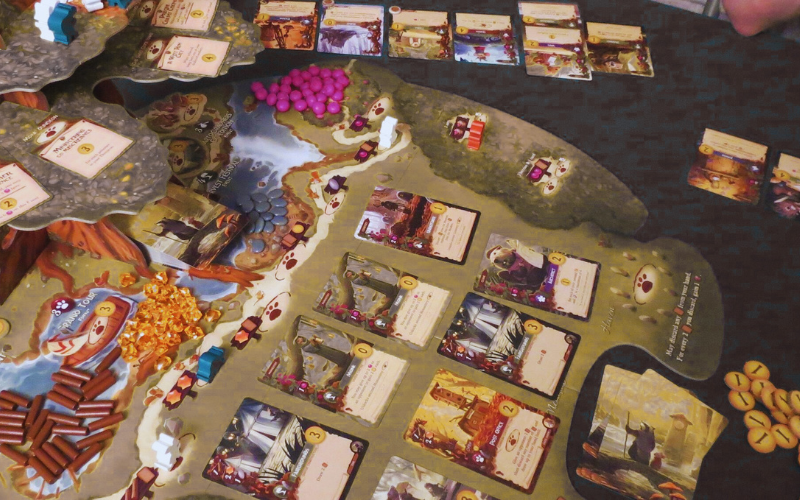
At heart, Everdell is worker placement plus tableau building. You place workers to gather resources and trigger locations, then spend those resources to play cards into your personal “city.” Those cards create combos, discounts, free plays, and little economic miracles. The joy is watching your scrappy starting turns turn into a late-game machine where everything chains into everything and you’re whispering, “Okay… okay… this is working.”
The setup
The board gives you shared locations to use, a central meadow of face-up cards to draft from, and a big deck of adorable, potentially life-ruining options. Everyone starts small: a couple of workers, not much income, and big dreams. As the game progresses through seasons, you’ll add more workers and unlock stronger plays—so you’re not just building a city, you’re building momentum.
How it plays
On your turn you do one of the core actions: place a worker to gain resources or activate a spot, play a card (from your hand or the meadow), or prepare for the next season to refresh workers and level up your capacity. The tension comes from the constant squeeze: you never have enough resources, you never have enough card space, and the meadow will always show the exact card you want… right after someone else takes it with a smile.
The best part is the combo logic. Many cards reward specific pairings (the right critter makes a building cheaper or free), and once you see those connections, the game turns into a satisfying “build the engine” puzzle instead of a random card soup.
Why the pacing works
- Early game: everything is tight—every twig matters, and you’re mostly trying to get your basics online
- Midgame: your engine starts to hum, turns get more interesting, and the meadow becomes a shopping mall you can’t afford
- Late game: big turns, big chains, and that classic feeling of “I’m doing ten things… but also why is it already ending?”
Table feel
Everdell is interactive, but not aggressive. You’re sharing worker spots and drafting from the same public display, so there’s plenty of “you took my card” and “why are you in my favorite location again,” but it doesn’t feel like a brawl. It’s more like friendly competition with occasional polite sabotage. It’s best at 2–3 where you have breathing room to build, while 4 can feel tighter and more competitive on shared spaces (which some groups love, and some groups find a bit cramped).
Who it’s for
- Groups who love cozy themes with real strategy underneath
- Players who enjoy engine building, card combos, and optimizing without constant conflict
- Best for medium-weight nights where you want something satisfying but not crushing
- You’ll like it if you enjoy games where your “city” feels personal and unique by the end
Less ideal for
- Not great for players who want direct conflict, negotiation, or high-drama interaction
- Avoid if your group gets frustrated by card draw variance (you’ll adapt, but you can’t fully control the deck)
- Also note: it rewards planning, so analysis-paralysis players can slow it down if the table doesn’t keep turns moving
Desert Meeples Beginner Tip + Verdict
New to Everdell? Don’t try to build the perfect city on turn one. Focus on getting resource flow and card draw early, and look for obvious pairings (a building that makes a critter free is basically the game winking at you). Also, keep an eye on your city limit—nothing hurts like drawing great cards and realizing you’ve built a beautiful town with no room left for anything important.
Verdict: Everdell is charming, clever, and consistently satisfying—the kind of game that makes you feel like a genius woodland architect even while you’re quietly panicking about berries. It’s approachable, but it has depth, and when your engine comes together, it’s one of the nicest “I built this” feelings in modern board games.

