
Quick Specs
 Party / Creative / Storytelling
 8+
8+ ~1.2/5 (Light)
 3–8 (best at 4–6)
 ~30 min
 Clue-Giving, Interpretation, Voting, Hand Management (cards), Light Bluffing
Dixit is the game where you look at a dreamy, surreal illustration and confidently say something like “Tuesday energy,” then watch your friends argue about whether that means a staircase, a moon, or emotional damage. It’s gentle, funny, and weirdly revealing—in the best way—because the real game isn’t “being clever,” it’s learning how your group thinks.
What it is
This is a creative party game about giving clues to abstract art. One player is the storyteller each round and gives a clue—anything from a sentence to a sound, a lyric fragment, or a dramatic one-word vibe. Everyone else plays a card from their hand that they think matches the clue, then everyone votes on which card they think was the storyteller’s.
The magic is in the balance: your clue should be specific enough that some people find you, but not so obvious that everyone does. If everyone guesses you, you score poorly. If nobody guesses you, you also score poorly. Dixit rewards being just the right amount of mysterious.
The setup
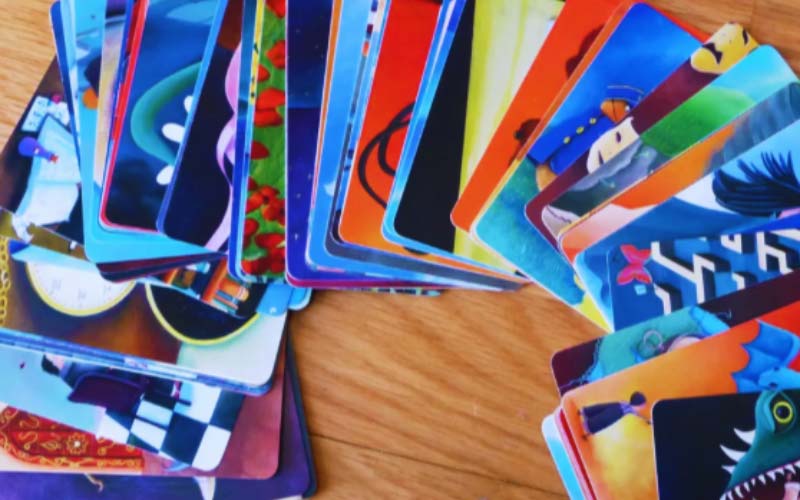
Players hold hands of large illustrated cards—beautiful, strange, and open to interpretation. Every round, a new storyteller chooses one card and sets the tone with a clue. Everyone else tries to blend in, like they’re smuggling their card into the storyteller’s brain.
How it plays
Storyteller gives a clue. Other players submit a card. The cards are shuffled and revealed. Everyone votes for the card they believe belongs to the storyteller. Points are awarded based on whether the storyteller was guessed by some (but not all), and whether players successfully tricked others into voting for their card.
It’s fast and simple, and the tension is friendly: can you land in that perfect zone where two people immediately get you, two people confidently don’t, and one person says “I hate that this makes sense.”
Why the pacing works
- Early game: clues are safe, literal, and everyone is learning the table’s vibe
- Midgame: the best part—people get bold, inside jokes appear, and the bluff cards get dangerously convincing
- Late game: you start tailoring clues to specific players like you’re running a social experiment, and it somehow works
Table feel
Dixit is low-stress, high-laughter, and surprisingly warm. It’s competitive, but it doesn’t feel mean—more like a shared creative puzzle. It’s excellent for mixed groups, families, and anyone who wants a party game with no shouting, no confrontation, and no rules overhead. Best at 4–6, where you get enough variety without the voting feeling random.
Who it’s for
- Groups who love creativity, conversation, and “that’s so you” moments
- Players who enjoy wordplay, associations, and reading people gently
- Best for families, mixed experience tables, and chill gatherings
- You’ll like it if you want a party game that feels like a cozy group activity
Less ideal for
- Not great for players who want direct strategy, tight control, or competitive precision
- Avoid if your group has big language gaps and prefers literal clues (it can still work, but the vibe shifts)
- Also note: the fun depends on people leaning in—if everyone plays super safe, it can feel flat
Desert Meeples Beginner Tip + Verdict
New to Dixit? Your clue should be a “maybe” for most people, not a “yes” for everyone. Aim for something that fits your card well but could reasonably fit two or three others. If you’re stuck, go emotional: a mood, a memory, a movie-style tagline. Also, don’t overthink the art—your friends will do that for you.
Verdict: Dixit is a modern classic for a reason: beautiful cards, simple rules, and a vibe that makes people talk and laugh without pressure. It’s the perfect “everyone can play this” game—where the only real skill is being just mysterious enough to be guessed… but not too guessed.

